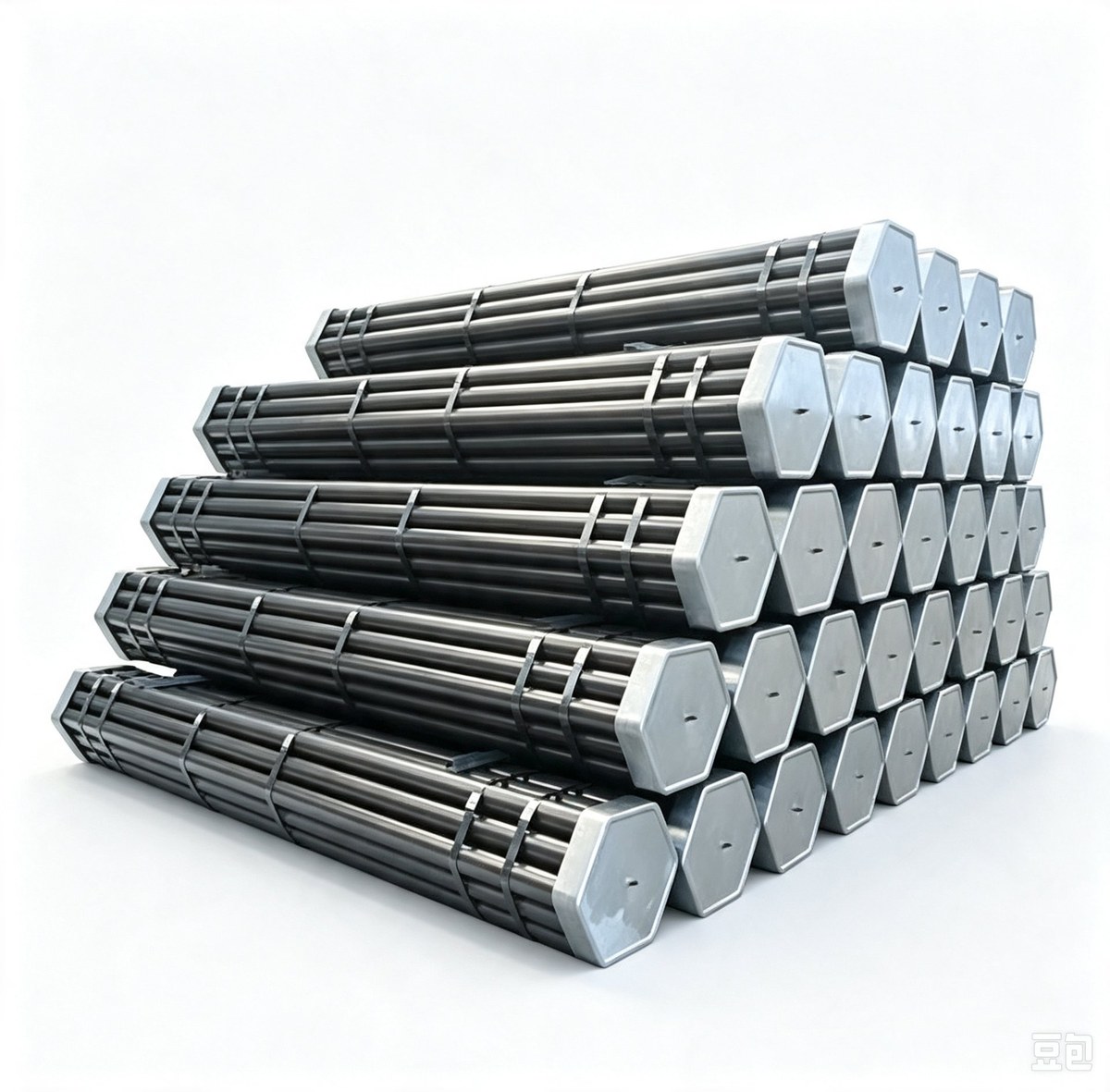
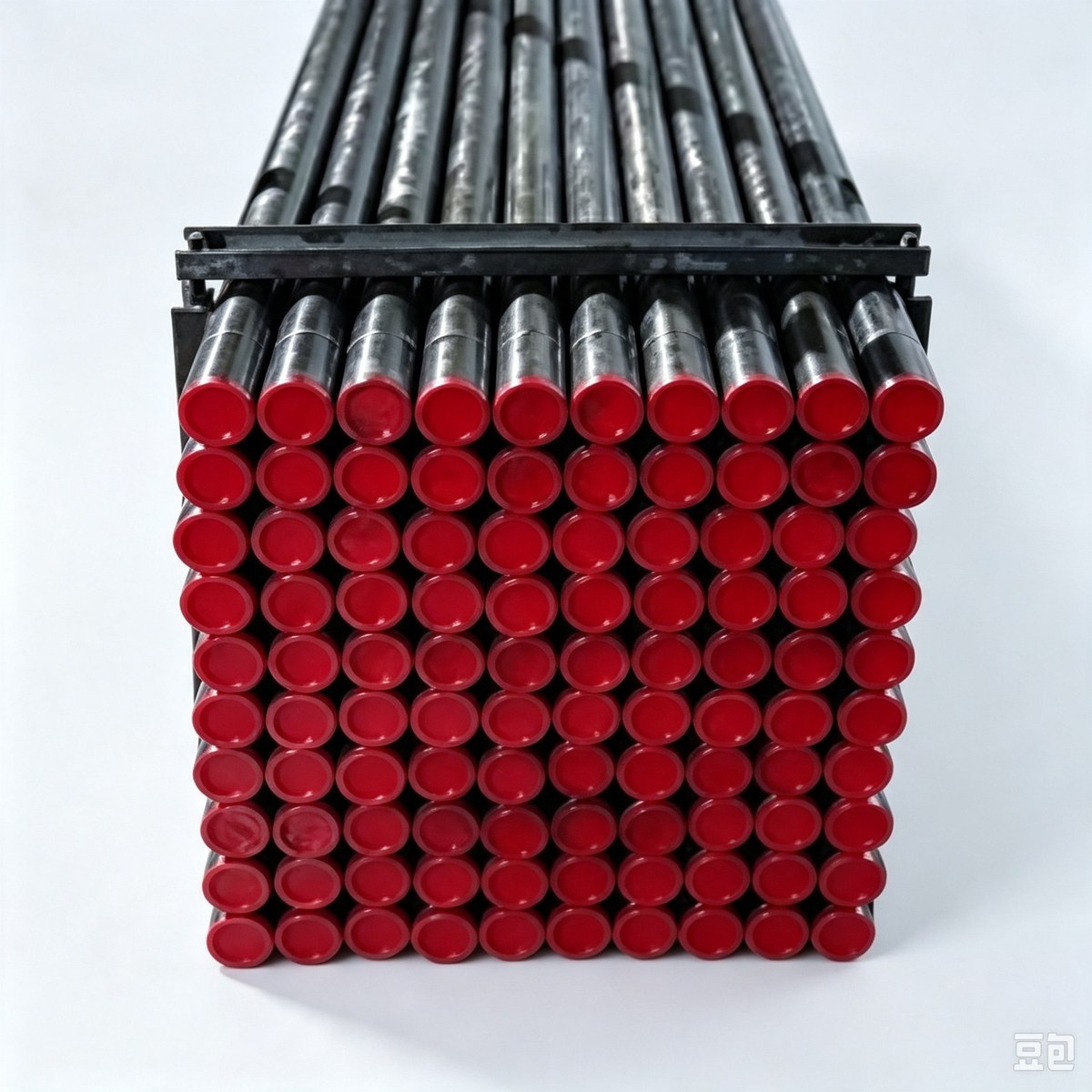
Drill Pipe
Product Overview
Drill pipe is a hollow, thick-walled steel pipe that serves as the critical conduit for transmitting rotational power and drilling fluid from the surface to the drill bit during oil and gas drilling operations. It forms the major component of the drill string and must withstand severe internal pressure, external pressure, torsion, bending, tension, and vibration simultaneously.
Unlike casing and tubing which remain in the wellbore, drill pipe is repeatedly run in and out of the hole, making it the most heavily loaded and frequently handled tubular product in drilling operations. A typical 4,000-meter string of 5-inch drill pipe weighs approximately 150 tons, with each square centimeter of pipe cross-section bearing 4.5 tons of load, while the uppermost sections simultaneously endure over 2,000 meter-tons of torque and internal pressures up to 2,024 MPa.
Product Types
- Drill pipe products encompass a broad family of drilling tools and accessories:
1 API Drill Pipe
The most common type, consisting of a steel pipe body with upset ends and welded-on tool joints at both ends. The tool joint (the threaded connection) has a wall thickness approximately three times that of the pipe body to provide the necessary strength for makeup and breakout operations.
2.2 Heavy Weight Drill Pipe (HWDP)
- A transitional pipe used between standard drill pipe and drill collars. HWDP features:
- Wall thickness 2–3 times greater than standard drill pipe
- Extended tool joints with longer length
- Specially reinforced center section (wear pads) with hardfacing to withstand compression loads
Designed to smooth the stiffness transition between drill collars and standard pipe, reducing fatigue damage
In directional drilling, HWDP can partially replace drill collars to reduce torque and prevent differential sticking
2.3 Drill Collars
Heavy, thick-walled tubulars (typically solid or spiral) that provide weight on bit (WOB) and maintain hole inclination. Common specifications include:
- 8″ OD, 6-5/8″ REG connections, right-hand spiral, ≥150.2 ppf
- 6-1/2″ OD, 4-1/2″ IF connections, ≥91.1 ppf
- 4-3/4″ OD, 3-1/2″ IF connections, ≥50.1 ppf
2.4 Kelly / Square Drill Pipe
Used at the top of the drill string to transmit rotary motion from the rotary table to the drill string. Available in 3-1/2″ to 4″ square or hexagonal cross-sections.
2.5 Geological Drill Pipe (Exploration Drilling)
Specifically designed for mineral exploration, geotechnical investigation, and core sampling applications with lighter weight and smaller diameters compared to petroleum drill pipe.
2.6 Trenchless / Directional Drilling Pipe
Engineered for horizontal directional drilling (HDD) and utility installation applications where surface disturbance is minimal. These pipes require enhanced fatigue resistance and specialized connections for curved bore paths.
2.7 Wireline Coring Pipe
Specialized pipe used in core sampling operations where the core barrel is retrieved through the drill pipe without tripping the entire string. Features smooth internal bore with coupling sizes matched to core barrel outer diameters.
3. Applicable Standards
3.1 International Standards
| Standard | Description |
|---|
| API SPEC 5DP / ISO 11961 | Primary global specification for steel drill pipe with upset pipe-body ends and weld-on tool joints, covering three Product Specification Levels (PSL-1, PSL-2, PSL-3) |
| API 7 / ISO 10424-1 | Rotary drilling equipment – Rotary drill stem elements |
| ISO 10424-2 | Threading and gauging of rotary shouldered thread connections |
| API 5B | Threading, gauging, and thread inspection for casing, tubing, and line pipe |
| API 5CT / ISO 11960 | Casing and tubing specifications (referenced for related OCTG products) |
| NACE TM0177 / ISO 15156 | Laboratory testing for sulfide stress cracking and stress corrosion cracking in H₂S environments |
3.2 Chinese National Standards
| Standard | Description |
|---|
| SY/T 5200 | Drill stem subs (tool joints and accessories) |
| GB/T 20657 | Petroleum and natural gas industries – Formulae and calculation for casing, tubing, drill pipe and line pipe properties |
3.3 Product Specification Levels (PSL)
- API 5DP defines three levels of manufacturing and testing stringency:
| Level | Description |
|---|
| PSL-1 | Basic requirements covering standard drill pipe performance |
| PSL-2 | Enhanced requirements with stricter inspection and testing |
| PSL-3 | Highest level with additional testing including full-size hardness inspection and higher flaw detection frequency; typically required for deep wells, offshore drilling, and high-risk environments |
4. Steel Grades
4.1 API Standard Grades (API 5DP / ISO 11961)
| Grade | Minimum Yield Strength (psi) | Minimum Yield Strength (MPa) | Tensile Strength (psi) | Typical Application |
|---|
| E-75 | 75,000 | 517 | 100,000 | Shallow to medium-depth wells (10,000–15,000 ft); most ductile with best corrosion resistance |
| X-95 | 95,000 | 655 | 105,000 | Medium-depth drilling environments |
| G-105 | 105,000 | 724 | 115,000 | Deep well drilling; high-strength grade widely used in demanding applications |
| S-135 | 135,000 | 931 | 145,000 | Ultra-deep wells and high-torque drilling operations; highest standard API strength grade |
4.2 Upset Types and Corresponding Grades
- Three upset types determine how pipe ends are thickened before tool joint welding:
| Upset Type | Abbreviation | Description | Typical Grades |
|---|
| Internal Upset | IU | Internal diameter reduced at pipe ends; outside remains nominal | E, X |
| External Upset | EU | External diameter increased at pipe ends; inside remains nominal | E, X, G, S |
| Internal-External Upset | IEU | Both internal and external diameters modified at pipe ends | E, X, G, S |
4.3 Special Service Grades
| Grade Type | Description |
|---|
| Sour Service Grades | Proprietary heavy-wall pipe for tool joints specifically heat-treated (quenched and tempered) to resist H₂S embrittlement, tested per NACE TM0177 Method A Solution A |
| High-Toughness Grades | Enhanced Charpy impact properties at low temperatures, tested at –20°C, –45°C, and –60°C |
5. Dimensions and Lengths
5.1 Common Outside Diameters and Nominal Weights
| OD (inches) | OD (mm) | Nominal Weight (lb/ft) | Wall Thickness (inches) | Typical Connections |
|---|
| 2-3/8″ | 60.3 | 6.65 | 0.280 | NC26 |
| 2-7/8″ | 73.0 | 10.40 | 0.362 | NC31 |
| 3-1/2″ | 88.9 | 13.30 / 15.50 | 0.368 / 0.449 | NC38 |
| 4-1/2″ | 114.3 | 16.60 (IEU) / 16.60 (EU) | 0.337 | NC46 / NC50 |
| 5″ | 127.0 | 19.50 | 0.362 | NC50 |
| 5-1/2″ | 139.7 | Varies | Varies | 5-1/2″ FH or high-torque proprietary |
5.2 Length Ranges
| Range | Length Range | Application |
|---|
| Range 1 (R1) | 18 – 22 ft (5.49 – 6.71 m) | Shorter pipes, often used for production tubing |
| Range 2 (R2) | 27 – 31 ft (8.23 – 9.45 m) | Standard length for most drilling operations; provides optimal balance between handling efficiency and operational convenience |
| Range 3 (R3) | 38 – 45 ft (11.58 – 13.72 m) | Deepwater drilling applications; reduces number of connections per stand but increases load on each tool joint |
Note: In drilling operations, 2–3 singles are typically joined to form a "stand" of 24–28 meters (approx. 80–90 ft) stored vertically in the derrick.
6. Thread Connections
6.1 API Rotary Shouldered Connections (RSC)
| Connection Type | Description | Typical Applications |
|---|
| NC (Numbered Connection) | Standard API connections with NC designation (e.g., NC26, NC31, NC38, NC46, NC50) | Modern standard for most drill pipe |
| REG (Regular) | 6-5/8″ REG and other sizes | Drill collars and bottom hole assemblies |
| FH (Full Hole) | 5-1/2″ FH – optimized for maximum internal diameter | Large-diameter drilling operations |
| IF (Internal Flush) | 4-1/2″ IF, 3-1/2″ IF – designed for smooth internal bore | General drilling; also available in left-hand (reverse) configurations for specialized applications |
6.2 Premium / Proprietary Connections
| Connection Type | Description |
|---|
| High-Torque Connections | Engineered for increased torsional capacity to prevent back-off and handle demanding drilling conditions (e.g., DS40, and other high-torque proprietary designs) |
| Sour Service Connections | Specially designed for H₂S environments with enhanced toughness and hardness controls |
| Left-Hand (Reverse) Connections | Available in IF configurations for applications requiring reverse rotation (e.g., 5″ 4-1/2″ IF Reverse, 3-1/2″ IF Reverse) |
7. Coatings and Hardbanding
7.1 Internal Coatings
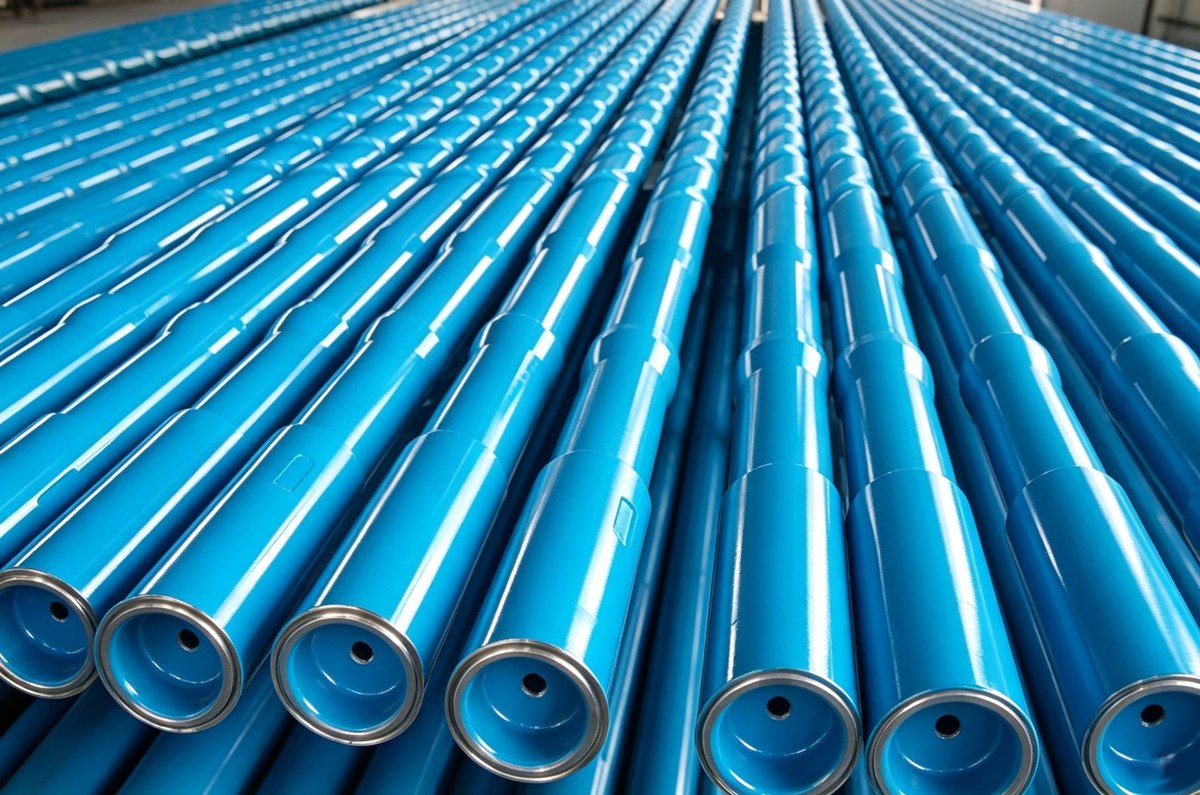
Internal coatings protect the drill pipe bore from corrosion and reduce friction during fluid circulation. Common coating types include:
| Coating Type | Description |
|---|
| TC-2000 | Widely used in Chinese and international markets for general corrosion protection |
| TK-34 / TK-34P / TK-34XT | Thermoset coatings with enhanced abrasion and chemical resistance |
| DPC | Premium internal coating with advanced polymer technology |
7.2 Hardbanding / Wear Protection
Hardbanding refers to the application of wear-resistant alloy materials on the tool joint outer diameter to protect both the drill pipe and the casing from mutual abrasion during rotation. Common types include:
| Hardbanding Type | Description |
|---|
| ARNCO-100 / 200 / 300 | Industry-standard hardbanding materials with varying abrasion resistance and casing-friendly properties |
| BOTN-1000 / 3000 | Chinese-developed hardbanding products with excellent wear resistance |
8. End Finishes and Tool Joint Configurations
8.1 Tool Joint Types
- Each drill pipe single consists of:
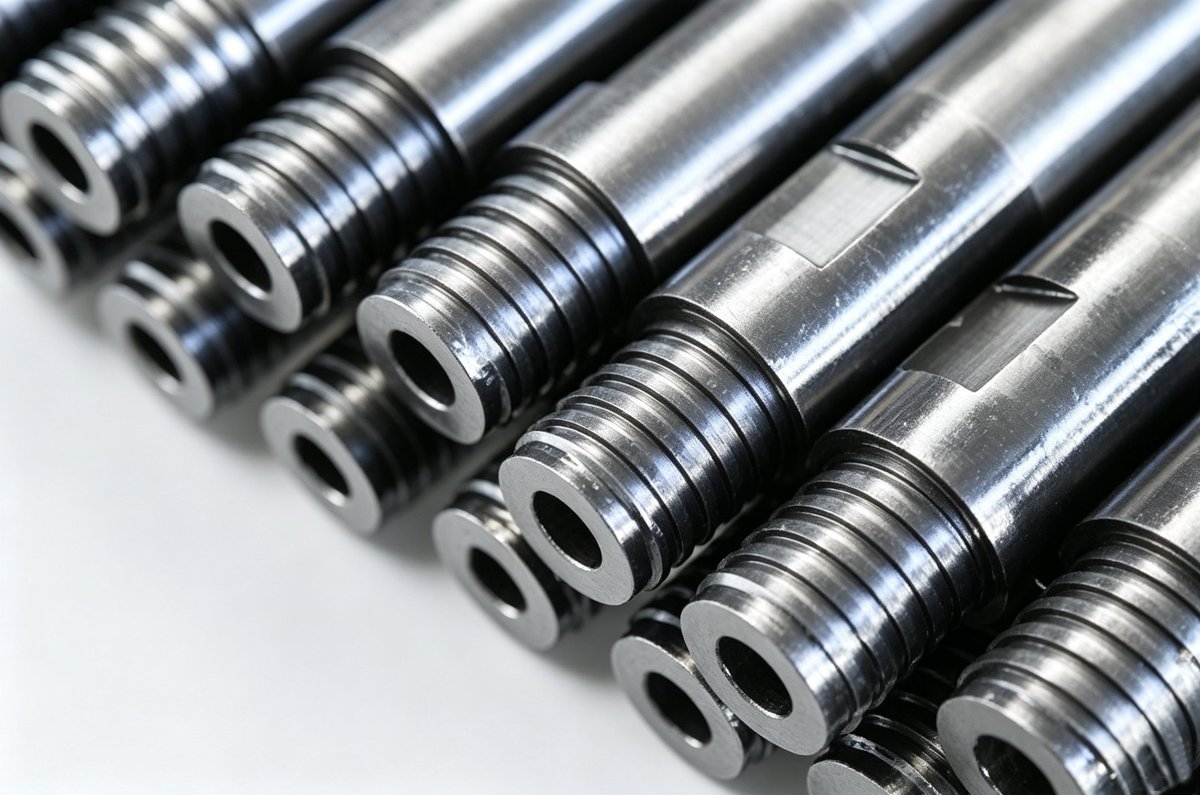
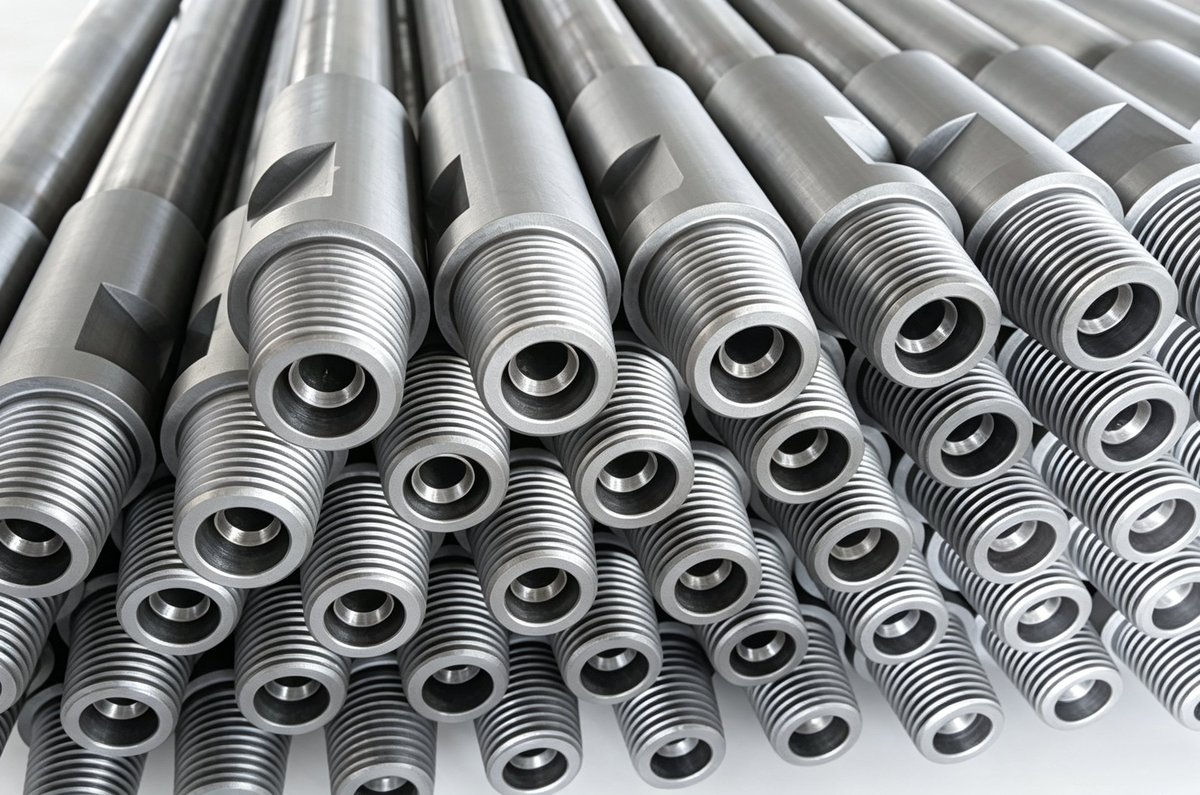
- Pin End: Male threaded connection
- Box End: Female threaded connection
Tool joints are welded onto upset pipe body ends after the upsetting process. The connection is designed for rapid makeup and breakout while withstanding high torque.
8.2 End Finishes
| Finish Type | Description |
|---|
| API Standard Tool Joint | Welded-on connection per API 5DP specifications with PSL-1, PSL-2, or PSL-3 quality levels |
| Hardbanded Tool Joint | Tool joint OD coated with wear-resistant alloy for casing protection |
| Special Clearance Tool Joint | Reduced OD for tight hole conditions |
9. Accessories and Components
- Drill stem systems require various accessories:
| Accessory | Description |
|---|
| Kelly | Square or hexagonal drive pipe at the top of the string; transmits surface rotation |
| Safety Clamp | Device used to secure drill pipe during connection makeup and breakout (e.g., WA-C, clamping range 3-1/2″ – 13-5/8″) |
| Elevators | Split-type or drilling-type elevators for lifting the drill string (e.g., DDZ, 133 mm ID, 2250 kN capacity) |
| Slips | Wedge-type gripping devices to suspend the drill string in the rotary table (e.g., SDXL for 5″ pipe, 3150 kN capacity; DCS-L for drill collars 6-3/4″ – 8-1/4″) |
| Drill Pipe Tongs / Power Tongs | Hydraulic or pneumatic tongs for makeup and breakout (e.g., 86–324 mm OD range, up to 75 kN·m torque) |
| Kelly Bushing / Drive Bushing | Square or hexagonal drive bushing to transfer rotary motion to the kelly |
| Thread Protectors | Plastic or steel caps to protect threads during transport and storage |
10. Packaging and Shipping
- Drill pipe packaging is critical to prevent damage during transit and storage:
1 Packaging Methods
| Method | Description |
|---|
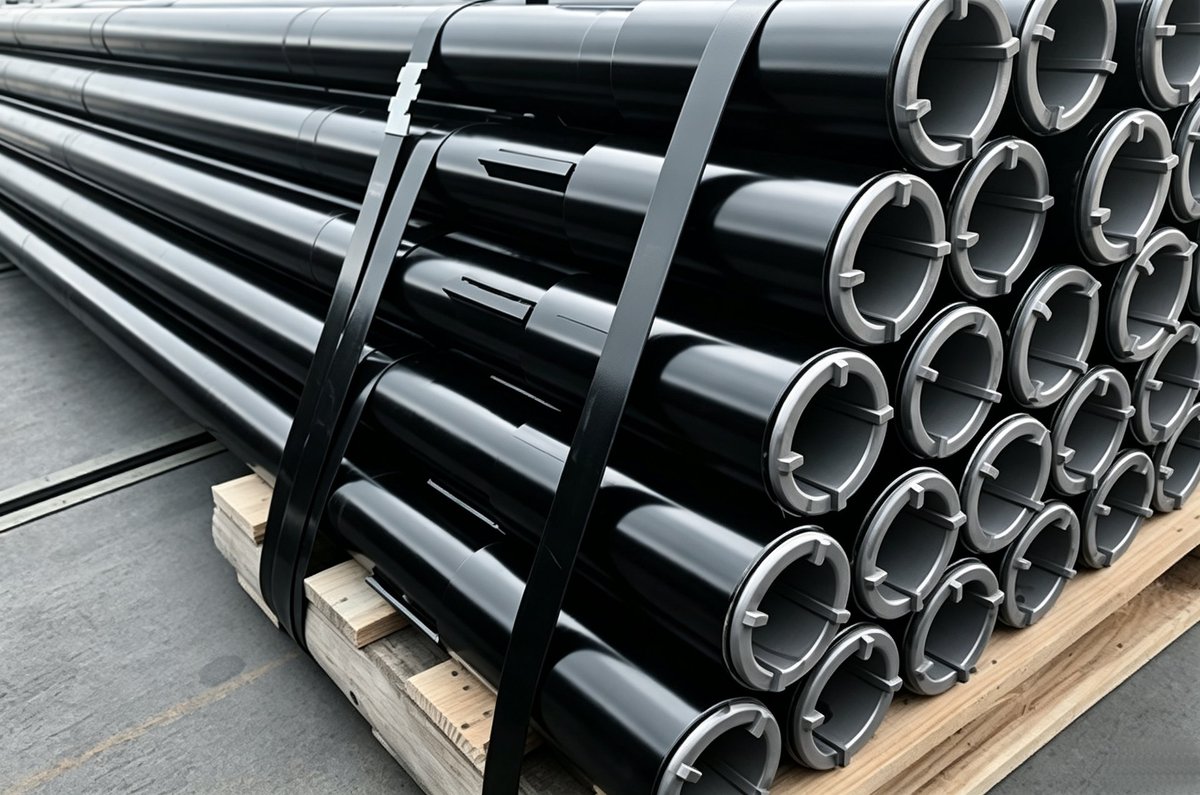
| Wooden / Steel Racks | Multiple racks placed along the pipe length to secure bundles; prevents rolling and contact between pipes |
| Cradles and Spacers | Timber or rubber cushions placed between pipe layers to prevent impact damage |
| Strapping | Steel straps or wire ropes with protective padding at contact points to avoid surface damage |
2 Transport Considerations
| Transport Mode | Key Requirements |
|---|
| Rail Transport | Clean wagon beds, timber/cotton rope padding along length, cushions between pipes and wagon walls, ensure couplings do not rest on padding |
| Truck Transport | Clean truck beds, timber spacers at minimum two points per pipe, rubber padding on flatbed steel frames; steel strap bundling with protective isolation |
| Ocean Transport | Proper dunnage to prevent rolling; avoid contact with harmful chemicals, seawater, or corrosive agents; protect pipe ends from impact |
3 Packaging Protection Measures
- Thread protectors on both ends of each pipe
- Internal coating application prior to shipment where specified
- Bundling in uniform bundles with proper identification labels
- Weather-resistant wrapping for ocean or long-term outdoor storage